Relaxed Cape Town City Walking Tour (2/3 of a day)
Discover the real Cape Town
Cape Town’s story isn’t found in a guidebook—it’s discovered by walking its streets, meeting its people and experiencing the city at a relaxed pace. On this private walking tour, one of our local hosts introduces you to the history, cultures, neighbourhoods and everyday life that have shaped Cape Town into the vibrant city it is today.
This is not a tour of ticking off landmarks. It’s about understanding the stories behind them. As we wander through the city, we’ll pause wherever curiosity leads us—a fascinating museum, an artisan workshop, a colourful side street or a neighbourhood café—taking the time to explore the places, people and conversations that bring Cape Town to life.
Because this is Cape Fusion, we believe the best way to understand a place is to experience it with all your senses. Along the way, we may stop for a locally roasted coffee, a traditional Cape treat or another favourite discovery—not as the focus of the tour, but as another way of experiencing Cape Town and connecting with the people who call it home.
As this is a private, tailor-made experience, the pace and focus are entirely yours. Prefer more shopping than museums? Fascinated by architecture, history or contemporary culture? Simply let your host know. This is your day, thoughtfully tailored around your interests.
Duration: 9:00am – 3:00pm, Monday to Saturday. (The city centre traditionally slows down on Sundays, so this tour operates Monday to Saturday.)
Good to Know
- Private, tailor-made: This tour only ever runs privately, for you and your travelling companions. Interested in shopping, architecture or contemporary culture as much as history? Just let your host know and we’ll tailor the experience around your interests.
- Museum choice: We’d recommend choosing one of the District Six Museum, the Tutu Legacy Foundation, or the Mandela Museum — they cover similar ground on apartheid history, so visiting all three would be repetitive. The South African Jewish Museum is also well worth a visit if it interests you.
- Fitness level: This is a walking tour, but the route is mostly flat and only requires a moderate level of fitness.
- Collection & drop-off: We collect and return you to central hotels, and are happy to drop you elsewhere centrally afterwards — Table Mountain, for instance.
- Sundays: The city centre traditionally shuts down on Sunday, so this tour runs Monday to Saturday only.
- Cost: As every tour is private, pricing depends on group size and where you’re staying. Email us with your group size and accommodation and we’ll send you a quote.
Make It a Full Day
Continue discovering Cape Town by adding the Table Mountain Cableway or a visit to Kirstenbosch Botanical Gardens. We’ll happily help you create a full day that reflects your interests.
Book your private Cape Town experienceand enjoy a true taste of the city |
Below is a taste of the Relaxed Cape Town City Walking Tour:
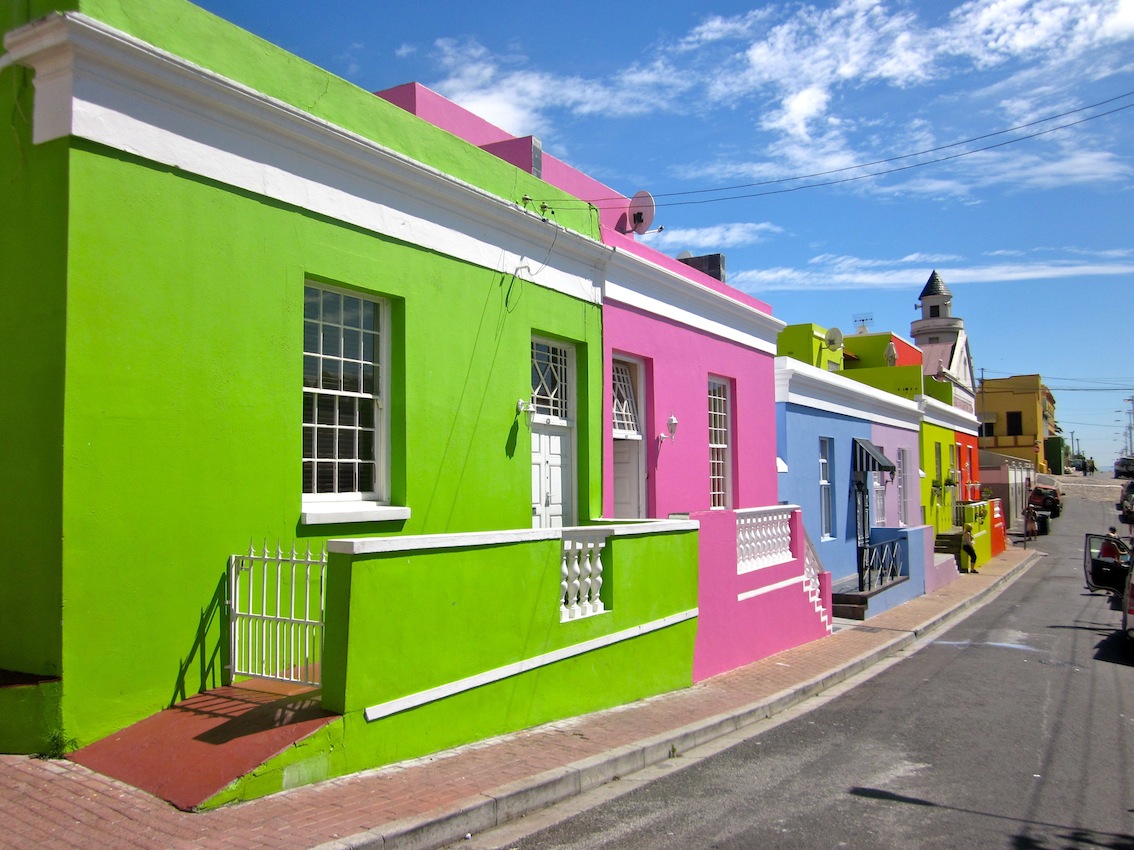
The Bo-Kaap: Cape Town’s Muslim Quarter
We begin in the Bo-Kaap, the jewel-coloured neighbourhood that was the only part of central Cape Town where people of colour were permitted to remain during apartheid. It’s home to the city’s oldest mosque and first madrassa, and today it’s still a tight-knit Cape Malay community with a proud, visible identity — you can see it in every painted house front.
No walk through the Bo-Kaap is complete without stopping for a koesister — a spiced local doughnut rolled in coconut, found nowhere else in the world. It’s a small bite, but it tells you everything about how this neighbourhood has kept its own traditions alive.

The Company’s Garden: Where Cape Town Began
From the Bo-Kaap we head down Wale Street toward the oldest part of the city — the Company’s Garden — pausing en route at a quiet, easy-to-miss fragment of the Berlin Wall, tucked beneath a tree at the start of St George’s Mall.
As we enter the Garden precinct, we pass St George’s Cathedral, spiritual home of Archbishop Desmond Tutu. In honour of his role in the fight against apartheid and in healing the divisions it left behind, an arch now stands at the Garden’s entrance — an Arch for the Arch.
Walking on through Government Avenue, we pass Parliament, Tuinhuis, the National Gallery, the Old and New Synagogues, the South African Museum, and the War Memorial Garden, before looping back through the Garden itself — the literal starting point of Cape Town’s history.
The story begins with scurvy. The Dutch East India Company was losing crew to the disease and ships to the lack of a safe stopover between Europe and the East. In 1649, a wrecked VOC ship’s survivors reported a freshwater river and friendly locals at the Cape. Three years later, in 1652, the VOC sent three ships south with a mandate: plant a fruit and vegetable garden, and build a ship repair station. That garden is the one you’re standing in.
Along the way, look out for:
- Queen Victoria’s statue in front of Parliament
- Tuinhuis, the President’s Cape Town office
- The Old and New Synagogues, viewed from the Gallery
- The War Memorial Garden
- Fresh produce growing in the Garden beds for the first time since the early 1700s
- A pear tree dating back to the late 1600s — the oldest tree in the Garden


The Slave Lodge and Church Square
From the Garden we pass the last surviving VOC Slave Lodge, searching out the plaque marking the spot — once shaded by a tree, long since gone — where enslaved people were auctioned. Directly across, on Church Square, a memorial of black granite blocks lists names and professions of the enslaved people once sold there. It’s a quiet, sobering stop, and one of the most important on this walk.

Slave Plaque where the slaves were auctioned off behind the Slave Lodge – under a tree


Buitenkant Street, Truth Coffee & District Six
We continue to Buitenkant Street, the city’s final edge and the border of District Six — the neighbourhood where more than 60,000 people were forcibly removed and their homes bulldozed under apartheid. We pause at Truth Coffee, a Cape Town micro-roaster, for a cup and a conversation about that history, before stepping into the District Six Museum itself. More than any other museum in the city, this one holds the happy memories — the sound, community, and everyday life of the people who once called District Six home.

The Castle, City Hall & Heritage Square
From there we walk past the Castle of Good Hope, Cape Town’s oldest surviving building, completed in 1679 as a military fort. Originally built on the shoreline and ringed by a moat, it’s hard to picture today — land reclamation now leaves it stranded well inland.
We pass City Hall and the parade ground, stopping to look up at the balcony where Nelson Mandela delivered his first speech as a free man, before winding back through the city to Heritage Square — built in 1771, home to some of Cape Town’s best restaurants, and the oldest grapevine in the city. Still bearing fruit after more than 250 years, she yields around 20 litres of wine a year, auctioned off for charity.
Our tour ends at Heritage Square for those who have not been diverted by shopping, art or other interests along the way! You can either stay on in the city for a glass of wine or two in vibey Bree Street or head back to your hotel!


We walk past City Hall and the military parade, pausing to check out the balcony of City Hall, which is where Mandela said his first speech as a free man.

Cape Fusion Tours has been sharing Cape Town’s stories — one bite, one street, one glass at a time — since 2002. Every tour is private, tailor-made, and led by a local host who calls this city home.Discover the Cape Over Three Unforgettable DaysWe believe the best way to experience Cape Town is to give yourself time to discover its many different sides. Our recommendation is simple: Day One – Explore the city’s history, neighbourhoods and cultures. Day Two – Discover the spectacular Cape Peninsula, its dramatic scenery and coastal communities. Day Three – Experience the Cape Winelands, where beautiful landscapes, exceptional wines and memorable food come together. Together, these experiences offer a true taste of the Cape. Explore our Cape Peninsula Tours – The relaxed Cape Peninsula Tour or the Taste the Cape Peninsula Food Tour
|